top of page

Updated: Apr 2, 2025

Another Crazy Day in AI: An Almost Daily Newsletter

Hello, AI Enthusiasts.


Lights are off, but AI is still running the show.


As Google DeepMind geared up to announce its new family of Gemini 2.0 models for robots, head of robotics Carolina Parada gathered her team for a final check of the technology’s capabilities.


Meanwhile, OpenAI kicks off a new era for the OpenAI Academy with a hub dedicated to enhancing AI literacy. Look out for free tools and insights that make AI friendly for all—no expert status required!


And if you think AI is just a trend, think again! In his new book, Business at the Speed of AI, OpenText CEO Mark J. Barrenechea reveals how AI will transform industries, redefine work, and drive groundbreaking discoveries.


That’s it for tonight—keep an eye on AI.


Here's another crazy day in AI:

  • Google's next step in AI-powered robots

  • OpenAI expands AI literacy with new learning hub

  • Mark Barrenechea’s vision in "Business at the Speed of AI"

  • Some AI tools to try out


TODAY'S FEATURED ITEM: Robots That Learn Like Humans


A robotic scientist in a classic white coat with 'AI Scientist' on its back stands beside a human scientist with 'Human Scientist' on their coat, looking towards the AI Scientist.

Image Credit: Wowza (created with Ideogram)


What if robots could learn new skills as intuitively as humans do?


Google DeepMind’s latest advancements in robotics introduce a new family of Gemini Robotics models, designed to help robots learn and adapt to a variety of real-world tasks. In an article on The Keyword, Joel Meares shares how these models are pushing the boundaries of what robots can learn and do. Built on Gemini 2.0, these models help robots process language, recognize objects, and perform complex physical tasks—all without needing to be retrained for each new challenge.


How the new generation of Gemini Robotics models was built:

  • Multimodal learning: The models are trained on diverse data types, including text, images, and actions, enabling robots to better understand their environment and engage with it in a more human-like manner.

  • Real-time adaptability: By incorporating feedback during training, these models allow robots to adjust their actions based on new information and unexpected situations, enhancing their problem-solving capabilities.

  • Task generalization: Instead of focusing solely on specific tasks, the models are designed to learn from a wide variety of activities, helping robots develop skills that can transfer across different scenarios.

  • Interactive training: Google’s team tested the models by having robots perform practical exercises, such as household chores and games, which helped refine their learning and adaptability.

  • Flexible architecture: The models can be implemented across various robotic platforms, from simple arms to more complex humanoid forms, making them suitable for numerous applications.

  • Collaborative testing: Working alongside researchers and engineers, the models were evaluated in different environments to ensure their reliability and versatility in real-world applications.

  • Continuous improvement: The development process includes ongoing iterations based on real-world performance, ensuring that the models evolve to meet new challenges and enhance their effectiveness.
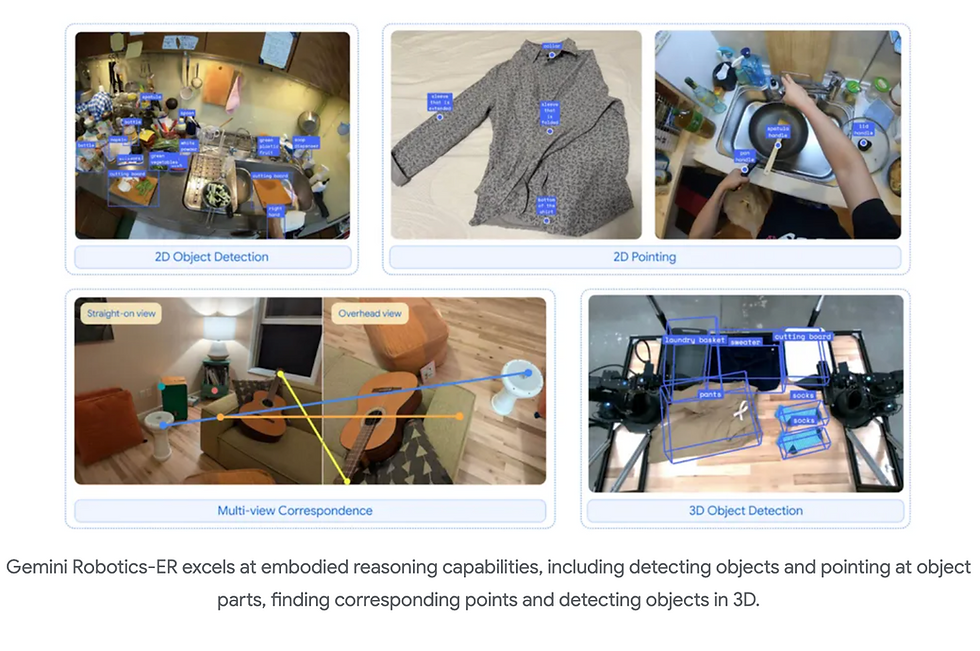

Source: Google
Source: Google

Traditionally, robots have been designed to perform specific tasks with great accuracy, often repeating the same actions over and over. While this approach works well in controlled environments, it can struggle in real-world situations where things can change unexpectedly. The new Gemini Robotics models mark a departure from this one-dimensional thinking. They’re built to adapt, allowing robots to learn from their experiences and respond to new challenges as they arise.


This ability to think on their feet opens up exciting possibilities for how robots can be used in various industries, including healthcare, logistics, and even our homes. Although we’re not quite at the point where robots can seamlessly integrate into our daily lives, innovations like these are getting us closer to that goal. Instead of just handling repetitive tasks, these advanced models are paving the way for machines that can truly understand, learn, and tackle complex problems in more meaningful ways.


Read the full article here.

OTHER INTERESTING AI HIGHLIGHTS:


OpenAI Expands AI Literacy with New Learning Hub

/OpenAI


OpenAI has launched a free online resource hub to expand AI literacy and accessibility for learners of all backgrounds. The OpenAI Academy will offer educational materials, workshops, and discussions, catering to educators, students, job seekers, and nonprofits. Partnering with institutions like Georgia Tech and Goodwill, the Academy aims to empower individuals with AI skills for personal and professional growth. Future plans include multilingual content, community groups, and global collaborations.


Read more here.


Mark Barrenechea’s Vision in "Business at the Speed of AI"

/Mark J. Barrenechea, CEO & CTO, on OpenText


AI is set to transform every industry over the next decade, from business and healthcare to climate science and education. In his new book, Business at the Speed of AI, OpenText CEO Mark J. Barrenechea explores how AI-driven digital labor will redefine work, increase human potential, and unlock groundbreaking discoveries. With AI advancing knowledge work, cybersecurity, and automation, Barrenechea envisions a future where human and AI collaboration reshapes civilization.


Read more here.

Source: Mark Barrenechea, Business at the Speed of AI

SOME AI TOOLS TO TRY OUT:


  • JuliusAI – Chat with your data files for expert insights and stunning visualizations.

  • ChatBox – Your AI copilot for writing, summarizing, math, and more.

  • Purposewrite – Instantly generate and refine content for blogs, emails, and social posts.


That’s a wrap on today’s Almost Daily craziness.


Catch us almost every day—almost! 😉

EXCITING NEWS:

The Another Crazy Day in AI newsletter is on LinkedIn!!!


Wowza, Inc.

Leveraging AI for Enhanced Content: As part of our commitment to exploring new technologies, we used AI to help curate and refine our newsletters. This enriches our content and keeps us at the forefront of digital innovation, ensuring you stay informed with the latest trends and developments.


Another Crazy Day in AI: An Almost Daily Newsletter

Hello, AI Enthusiasts.


Monday night insights—what’s happening in AI?


The Digital Education Council has introduced an AI literacy framework for schools, emphasizing the importance of human skills alongside technical knowledge. Will this create a generation of AI whizzes?


Meanwhile, during Boise State’s ChatGPT Hackathon, faculty and staff collaborated to create 40 tailored GPT models to enhance their workflows.


In another corner of the AI world, Dartmouth’s clinical trial of the AI chatbot “Therabot” is showing significant promise for mental health treatment. Could AI be the therapy buddy we didn’t know we needed?


Let’s keep an eye on these developments! 


Here's another crazy day in AI:

  • The 5 Pillars of AI literacy

  • Faculty and staff build custom GPTs in AI workshop

  • Study finds AI therapy chatbot delivers promising results

  • Some AI tools to try out


TODAY'S FEATURED ITEM: Defining AI Literacy in Higher Ed


A robotic scientist in a classic white coat with 'AI Scientist' on its back stands beside a human scientist with 'Human Scientist' on their coat, looking towards the AI Scientist.

Image Credit: Wowza (created with Ideogram)


What does AI literacy look like in higher education?


The Digital Education Council (DEC) has introduced a framework to help higher education institutions build AI literacy among students and faculty. In an article for Campus Technology, Editor-in-Chief Rhea Kelly breaks down the report’s key insights, highlighting a human-centered approach that prioritizes not just technical understanding but also critical thinking, creativity, and ethical responsibility.


5 Dimensions of the DEC AI Literacy Framework

Five core dimensions of AI literacy:

  • Understanding AI and Data – Knowing how AI systems work, how data is collected and processed, and how to assess AI-generated content.

  • Critical Thinking & Judgment – Recognizing biases, evaluating AI outputs, and applying logical reasoning when using AI in decision-making.

  • Ethical & Responsible AI Use – Understanding fairness, privacy, and transparency while ensuring compliance with regulations and ethical guidelines.

  • Human Skills & Creativity – Strengthening adaptability, emotional intelligence, and communication to complement AI-driven processes.

  • Domain Expertise – Applying AI knowledge within a specific discipline while considering ethical and industry-specific implications.


5 Dimensions of the DEC AI Literacy Framework

Rather than treating AI literacy as a single skill, the framework breaks it down into specific competencies that students and faculty can develop over time. It also provides a roadmap for institutions, outlining practical steps for integrating AI education into different disciplines while keeping ethical considerations at the forefront.


Higher education is in a position to shape how AI is understood and applied in the real world. The ability to critically assess AI tools, recognize their limitations, and use them responsibly is becoming an essential part of learning—regardless of the field of study. By introducing structured approaches like this framework, institutions can help ensure that students graduate with both the technical knowledge and the critical awareness needed to engage with AI in meaningful ways.


For faculty and administrators, this raises important questions: How should AI literacy be taught? Where does it fit within existing curricula? And how can educators balance broad AI knowledge with subject-specific applications? The DEC’s framework offers a way to start addressing these questions, providing guidance on how AI literacy can become a core part of education rather than an optional add-on.


Read the full article here.

Download the DEC AI Literacy Framework here.

OTHER INTERESTING AI HIGHLIGHTS:


Faculty and Staff Build Custom GPTs in AI Workshop

/Boise State News


Boise State’s recent ChatGPT Hackathon brought together over 50 faculty and staff for a hands-on workshop to create custom AI tools. Hosted at Albertson’s Library, the event focused on helping participants design GPT models tailored to their professional and educational needs. Speakers from various university departments shared insights on AI theory, policy, and applications, leading to the development of 40 new GPTs, ranging from accessibility evaluators to career mentors. The event highlighted the power of AI in streamlining tasks and enhancing learning, leaving participants eager for future AI initiatives.


Read more here.


Study Finds AI Therapy Chatbot Delivers Promising Results

/Morgan Kelly on Dartmouth


Dartmouth researchers conducted the first clinical trial of an AI-powered therapy chatbot, “Therabot,” with promising results. Participants, diagnosed with depression, anxiety, or eating disorders, reported significant symptom improvements, with reductions comparable to traditional therapy. The chatbot provided real-time conversational support, with users engaging for an average of six hours over the study. While experts stress the need for clinician oversight, the trial suggests AI could bridge gaps in mental health care, particularly for those without immediate access to professionals.


Read more here.

SOME AI TOOLS TO TRY OUT:


  • Thea – Instantly generate AI-powered practice questions and study materials for any subject.

  • Zapier MCP – Turns AI assistants into action-taking tools by connecting them to 7,000+ apps.

  • MeetGeek – Automatically records, transcribes, and summarizes meetings, sending insights to your favorite tools.


That’s a wrap on today’s Almost Daily craziness.


Catch us almost every day—almost! 😉

EXCITING NEWS:

The Another Crazy Day in AI newsletter is on LinkedIn!!!


Wowza, Inc.

Leveraging AI for Enhanced Content: As part of our commitment to exploring new technologies, we used AI to help curate and refine our newsletters. This enriches our content and keeps us at the forefront of digital innovation, ensuring you stay informed with the latest trends and developments.


Another Crazy Day in AI: An Almost Daily Newsletter

Hello, AI Enthusiasts.


Before you close out the week, a quick AI rundown:


AI is rewriting the marketing playbook. On AI Today Podcast, experts break down how businesses are using hyper-personalization, predictive analytics, and automation to target audiences with surgical precision.


Meanwhile, Zendesk’s new AI agents don’t just chat—they solve. With advanced reasoning, they can troubleshoot issues without human help.


And here’s a hot take to leave you with: a creative technologist argues that dismissing ChatGPT’s new image model as “just style transfer” overlooks the true power of multimodality.


That’s a wrap—go recharge before Monday’s madness.


Here's another crazy day in AI:

  • Marketing in the intelligent age

  • Zendesk’s AI agents aim for 80% automation in customer support

  • The point of multimodality and why it’s bigger than style transfer

  • Some AI tools to try out


TODAY'S FEATURED ITEM: What AI Means for Modern Marketing


A robotic scientist in a classic white coat with 'AI Scientist' on its back stands beside a human scientist with 'Human Scientist' on their coat, looking towards the AI Scientist.

Image Credit: Wowza (created with Ideogram)


What if you could predict exactly what your customers want—before they even know it themselves?


Marketing has always been about getting the right message to the right people at the right time. But with AI, businesses can now do this with a level of precision that wasn’t possible before.


In a recent episode of the AI Today podcast, hosts Kathleen Walch and Ronald Schmelzer explore the tangible ways artificial intelligence is transforming marketing practices. Their discussion moves beyond theoretical possibilities to examine how companies are actually implementing AI tools to enhance customer experiences and improve campaign performance.


Ways AI is Changing Marketing:

  • Hyper-personalization at scale – AI enables businesses to deliver tailored content and recommendations based on real-time insights.

  • Predictive analytics for better decisions – By analyzing past and present data, AI helps marketers anticipate trends and customer behavior.

  • Automated and optimized campaigns – AI streamlines marketing efforts by improving ad targeting, automating repetitive tasks, and refining messaging.

  • Deeper audience insights – AI-powered tools can track customer sentiment, analyze engagement, and provide a clearer picture of what resonates with consumers.


AI is giving marketers new ways to understand and engage with customers, but it’s not a magic solution. The real impact comes from how businesses use these tools—whether it’s improving customer experiences, making smarter decisions, or simply working more efficiently. It’s less about replacing traditional marketing and more about enhancing what already works.


That said, AI isn’t something you just plug in and expect instant results. It requires the right data, the right strategy, and a thoughtful approach to avoid over-reliance on automation. As more companies integrate AI into their marketing efforts, the challenge will be finding the balance between technology and the human touch—because at the end of the day, great marketing is still about connecting with people in a way that feels real and meaningful.


Read more here.

Listen on Spotify here. Listen on Apple Podcasts here.

OTHER INTERESTING AI HIGHLIGHTS:


Zendesk’s AI Agents Aim for 80% Automation in Customer Support

/OpenAI


Zendesk has partnered with OpenAI to build a new class of AI service agents that go beyond scripted responses to autonomously plan and execute resolutions. By integrating Retrieval-Augmented Generation (RAG) and advanced reasoning, these AI agents can adapt conversations, disambiguate customer needs, and execute workflows seamlessly. With automation rates nearing 80%, businesses can deploy these AI-driven service agents in minutes instead of days—bringing faster resolutions and smarter customer interactions.


Read more here.


The Point of Multimodality and Why It’s Bigger Than Style Transfer

/Creative Technologist, Bilawal Sidhu (@bilawalsidhu) on X


Many assume ChatGPT’s new image model is just another style transfer tool, but Creative Technologist Bilawal Sidhu argues it’s far more than that. Equipped with ControlNets, LoRAs, and advanced compositional abilities, this AI acts like a graphic designer, compositor, and creative partner all in one. From 3D perspective shifts to pixel-perfect text rendering, it’s collapsing traditional Canva, Figma, and VFX workflows into simple prompts. With video editing on the horizon, the future of AI-driven creativity is just getting started.


Read more here.

SOME AI TOOLS TO TRY OUT:


  • Reword – AI-powered collaboration for creating helpful, reliable, and people-first content.

  • Zendesk – AI-driven customer service and sales CRM for exceptional support experiences.

  • Ideogram 3 – An image generator with Style References and billions of preset aesthetics.


That’s a wrap on today’s Almost Daily craziness.


Catch us almost every day—almost! 😉

EXCITING NEWS:

The Another Crazy Day in AI newsletter is on LinkedIn!!!


Wowza, Inc.

Leveraging AI for Enhanced Content: As part of our commitment to exploring new technologies, we used AI to help curate and refine our newsletters. This enriches our content and keeps us at the forefront of digital innovation, ensuring you stay informed with the latest trends and developments.


Copyright Wowza, inc 2025
bottom of page